
On this page
Why do gutters sag?
Gutters sag when whatever holds them to the house stops holding. On many Fort Wayne houses that means spikes and ferrules, long nails driven through the gutter into the fascia, that have backed out a little more with every freeze and thaw. Hangers spaced too far apart, a trough left full of wet leaves or ice, and rotten fascia that cannot grip a fastener are the other common causes. Once a run dips, water collects in the low spot, adds weight and makes the sag worse.
How much does it cost to fix sagging gutters in Fort Wayne?
Rehanging a run is usually a moderate repair. Angi puts the national average for gutter repair at about $390, but the range is wide: a short run rehung on new hangers costs less, while a long second-storey run with rotten fascia and a bent section costs more. Get a written quote that separates the gutter work from any wood repair.
Causes and fixes
| Cause | What you see | Fix |
|---|---|---|
| Spikes backing out | Nail heads standing proud; gaps behind the gutter | Replace with hidden hangers screwed into solid wood |
| Wide hanger spacing | Gentle bow between fastenings | Add hangers at closer spacing |
| Ice and snow load | Bent hangers after winter | Rehang; consider heavier coil; address ice dams |
| Wet debris | Sag where leaves collect | Clean, rehang, consider guards |
| Rotten fascia | Fasteners pull out; soft wood | Replace fascia, then rehang |
| Ladder damage | Kinked section | Replace the section |
How sagging gutters are rehung
- Inspect. The contractor checks the fascia along the whole run, not just at the sag.
- Support and remove fasteners. Old spikes are pulled; loose hangers removed.
- Repair wood. Soft fascia is cut out and replaced.
- Re-pitch. A string line or level sets a steady fall to the outlet.
- Fasten. Hidden hangers are screwed through to solid wood or rafter tails at close spacing.
- Test. Water is run through to confirm it drains with nothing standing.
Winter and sagging in Fort Wayne
Winter is the main reason Fort Wayne gutters sag. The city averages about 33.6 inches of snow a year, and some winters bring far more: during the winter of the Great Blizzard of 1978, Fort Wayne recorded 60.6 inches of snow from December to February. Snow sliding off the roof, ice filling the trough and repeated freeze-thaw cycles all pull on gutter fastenings. Hidden hangers screwed into solid wood, at closer spacing than the bare minimum, hold up far better than spikes.
If the same gutters sag every winter and you see icicles and ice ridges at the eave, the root problem is probably ice dams. Better attic insulation and ventilation reduce the ice; stronger hangers handle what remains.
Where sagging is common
- Mid-century houses in Waynedale, New Haven and north Fort Wayne with original spike-and-ferrule gutters.
- Older homes in South Wayne, West Central and Lakeside where the fascia has softened after decades of overflow.
- Wooded lots in Aboite and Foster Park where gutters fill with heavy wet leaves.
Spikes vs hidden hangers
| Spike and ferrule | Hidden hanger | |
|---|---|---|
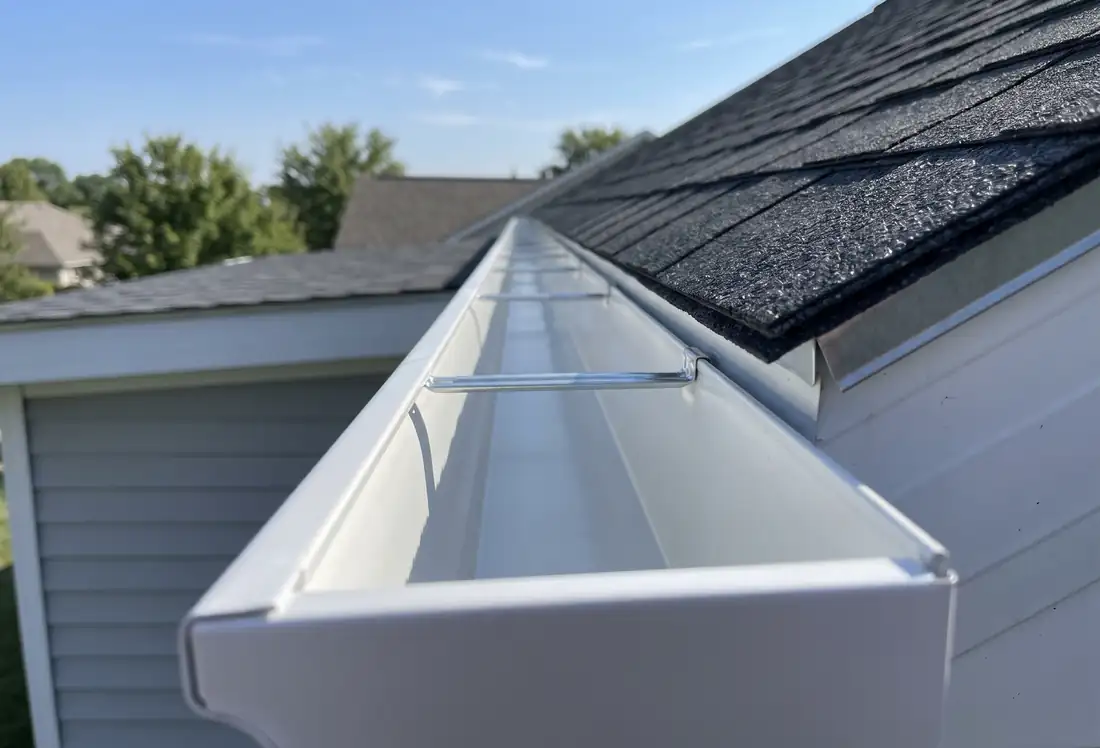
| How it holds | Long nail through a tube | Bracket inside the gutter, screwed to fascia |
| Holding power over time | Works loose with freeze-thaw | Holds well when screwed into solid wood |
| Look | Nail heads visible on the front | Hidden inside the trough |
| Typical on | Older installations | Modern seamless gutters |
When sagging means replacement
If the gutters are old, bent along much of their length, or the fascia behind them is rotten along several runs, replacement may be better value than repair. See gutter replacement and repair or replace.
What to ask about sagging gutters
- Why is this run sagging, and will the fix address that?
- Is the fascia solid along the whole run?
- What hangers and spacing will you use?
- Will you re-pitch the run and test it with water?
- Are bent sections being replaced?