
On this page
What do downspouts need to do?
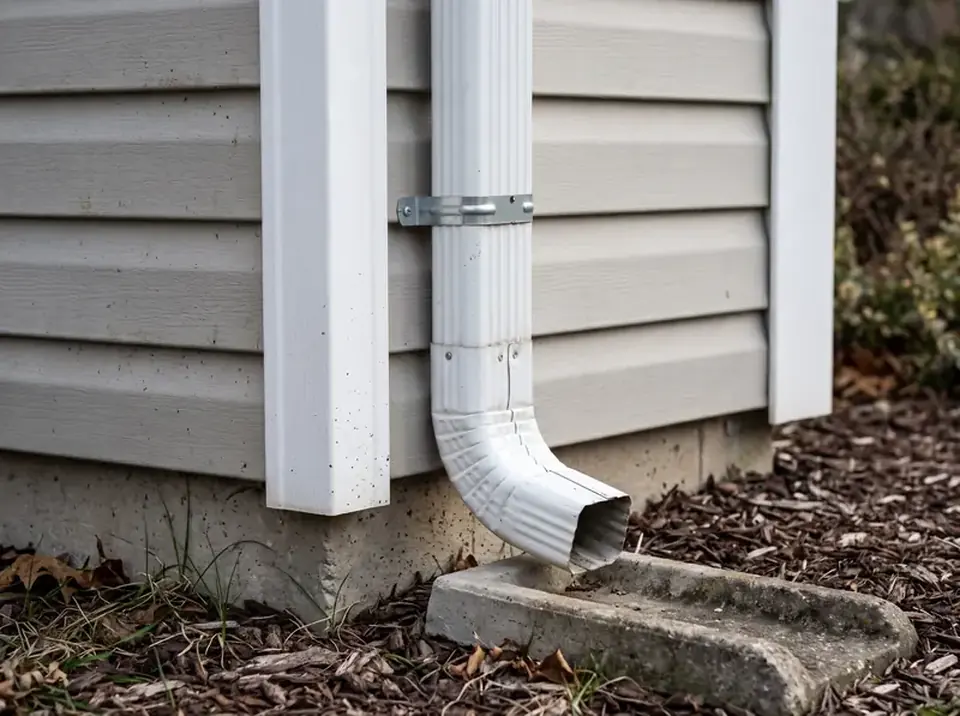
Downspouts carry water from the gutter outlet to the ground and then away from the house. The second part is the one that often goes wrong. A downspout that ends right at the foundation, with a missing or short extension, puts all the water from that section of roof into the soil next to the basement wall. On Fort Wayne's flat glacial ground, that water has nowhere to go but down.
Fort Wayne sits on land shaped by glaciers, with the Fort Wayne Moraine along the rivers and the flat lake plain of the old Great Black Swamp to the east. Clay-rich soil and little slope make good downspout discharge especially important here.
How much do downspouts cost?
Downspouts are usually part of a gutter quote rather than priced alone. National guides put seamless aluminum gutter systems at about $9 to $13 a foot installed, with downspouts counted in or charged per piece depending on the contractor. Larger 3x4 downspouts, extra elbows, long extensions, buried pipe and pop-up emitters add to the cost. Clearing or replacing a crushed underground line is a separate job.
Downspout sizes and parts
| Part | What it does |
|---|---|
| 2x3 downspout | Standard on 5-inch gutters |
| 3x4 downspout | Drains more, clogs less; pairs with 6-inch gutters |
| Round downspout | Used with half-round gutters |
| Outlet (drop) | Connects the gutter to the downspout |
| Elbows (A and B) | Turn the downspout to follow the wall and point it out |
| Extension | Carries water away from the foundation |
| Splash block | Spreads water so it does not dig a hole |
| Buried pipe / tightline | Carries water underground to a safe outlet |
| Pop-up emitter | Lets buried water out at the end of the pipe |
| Dispersion trench | A gravel trench that spreads water into the soil |
Where should downspouts go in Fort Wayne?
The goal is to put water on ground that slopes away from the house, far enough out that it soaks in or runs off without coming back toward the foundation. On a flat lot that often means longer extensions, a shallow swale, a buried pipe to a lower part of the yard, or a rain garden.
What to avoid:
- Ending downspouts at the foundation with no extension.
- Sending water onto a walkway or driveway where it will freeze in winter.
- Aiming water at a neighbor's property.
- Tying downspouts into a sewer where that is not allowed.
Downspouts and Fort Wayne's combined sewers
About a third of Fort Wayne is served by combined sewers, which carry both stormwater and wastewater, mostly in the older part of the city. City Utilities' stormwater guidance asks property owners to disconnect or redirect downspouts that appear to go into the ground, because they may be sending rainwater into a sewer that was not meant to take it. The city's Deep Rock Tunnel, nearly 5 miles long, opened in November 2024 to capture combined sewage that used to overflow into the rivers, but every downspout kept out of the sewer still helps.
Before disconnecting, make sure the water will go somewhere safe. Read downspouts and combined sewers for more.
Where downspout problems come up most
- Older neighborhoods such as West Central, South Wayne and Lakeside, where downspouts often run into the ground.
- Low, flat areas near the rivers, such as parts of Foster Park and Indian Village along the St. Marys.
- Houses with basements on flat lots in Waynedale and New Haven.
Signs a downspout needs work
- Water pools beside the wall after rain.
- The basement is damp along one wall.
- A trench has worn into the soil under the outlet.
- The downspout overflows at the top in heavy rain.
- The buried pipe backs up or the yard is soggy above it.
See downspout repair and downspout drainage and your foundation.
What to ask about downspouts
- Where will each downspout go, and where will it discharge?
- Is 3x4 worth it on my house?
- Do any of my downspouts run into a sewer, and what are the alternatives?
- How will you keep water off walkways and drives in winter?
- Is extension or buried pipe included?