
On this page
Are copper gutters worth it?
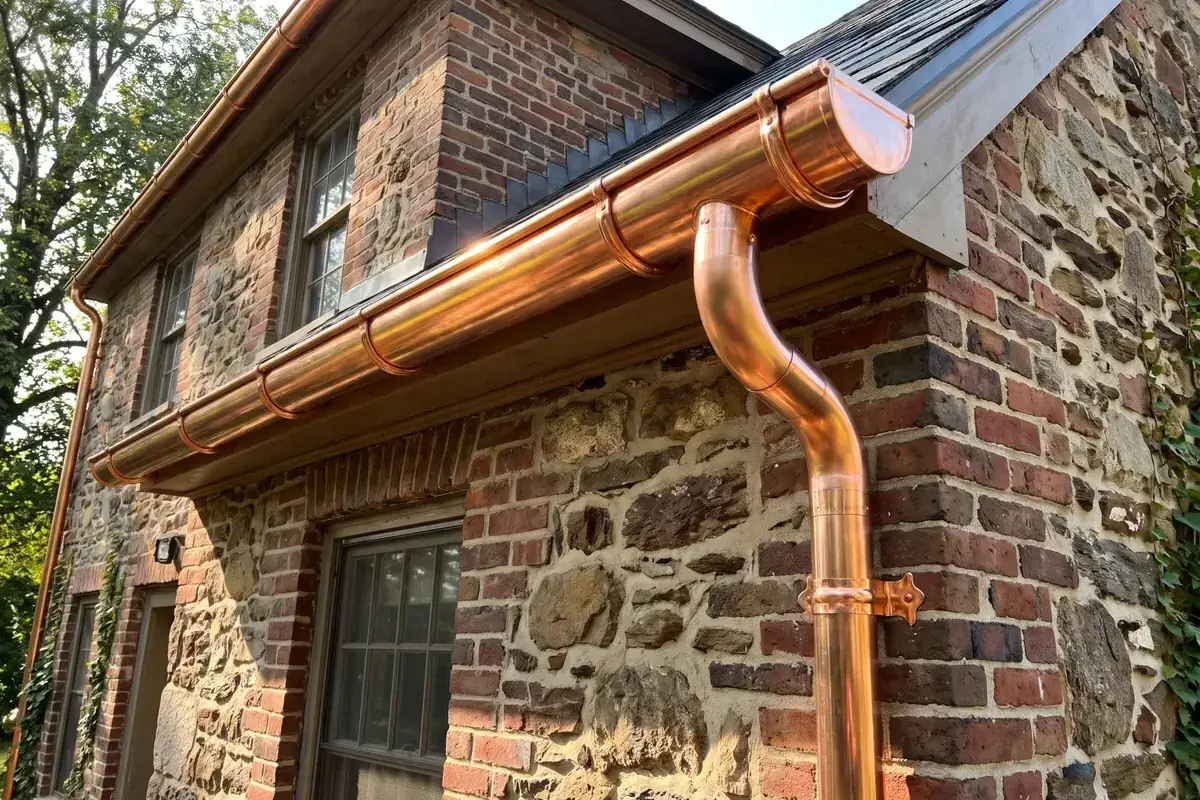
Copper gutters are worth it when you want a system that will outlast several roofs and suits a house where looks matter: a historic home, a brick or stone house, or a church. They cost several times more than aluminum, but they do not rust, they hold up to ice and hail better than thin aluminum, and they age to a patina that many owners like. On a typical vinyl-sided ranch, the cost rarely makes sense.
How much do copper gutters cost in Fort Wayne?
National guides put copper gutters at about $15 to $40 a foot installed, compared with about $9 to $13 for seamless aluminum. The thickness of the copper, the profile (half-round or K-style), soldered joints, decorative brackets and round downspouts all affect the price. Copper also needs a contractor who solders; not every gutter installer does.
Copper vs aluminum vs steel
| Copper | Aluminum | Steel | |
|---|---|---|---|
| National installed cost | ~$15–$40/ft | ~$9–$13/ft | ~$8–$13/ft |
| Lifespan | Many decades | 20+ years | Shorter once coating fails |
| Rust | No | No | Yes, where scratched |
| Dent resistance | Good | Fair; better with heavier coil | Good |
| Joints | Soldered | Sealed | Sealed |
| Look | Ages to brown, then green | Painted finish | Painted finish |
See aluminum vs steel vs copper for more.
Where copper fits in Fort Wayne
- Historic houses in West Central, Williams-Woodland Park, Southwood Park and Wildwood Park, among the 27 Fort Wayne historic districts on the National Register.
- Stone and brick houses in Indian Village and Foster Park.
- Churches and institutional buildings, where long life justifies the cost. See commercial gutters.
Copper in a Fort Wayne winter
Copper's strength is useful in snow country. Fort Wayne averages about 33.6 inches of snow a year, and repeated ice in the trough bends thin aluminum. Copper resists that better, and soldered joints do not open up with freeze and thaw the way sealant can. Hangers should still be closely spaced and made of copper or a compatible metal.
Things to know before choosing copper
- Galvanic corrosion. Copper must not touch aluminum or galvanized steel. Flashing, fasteners and downspouts should all be compatible.
- Staining. Runoff can leave green marks on limestone, light mortar or concrete. Place downspouts and splash blocks thoughtfully.
- Patina. New copper is bright; it darkens within months and greens over years. You can let it age or have it treated.
Box gutters and copper lining
Some older Fort Wayne houses have built-in box gutters in the cornice. Relining them with soldered copper is a traditional repair that keeps the original look. It is specialist work, so ask any contractor about their experience with box gutters.
What to ask about copper gutters
- What weight of copper are you quoting?
- Will joints be soldered?
- What brackets and fasteners will you use?
- How will you avoid contact with aluminum or galvanized metal?
- Have you lined box gutters before, if mine have them?
- What warranty covers the work?
A worked example
Here is an illustration, not a quote. A brick Tudor in Indian Village has 160 feet of eave. At the national range of about $15 to $40 a foot, copper half-round comes to roughly $2,400 to $6,400, compared with about $1,440 to $2,080 for seamless aluminum at $9 to $13 a foot. The owner who plans to stay decades, values the look and wants fewer replacements may find copper worth it; one planning to sell soon probably would not.
Looking after copper
- Clean gutters as you would any other, without scraping the metal.
- Leave the patina alone unless you want the bright look; treatments can slow it.
- Check soldered joints after hard winters.
- Keep aluminum ladders and fasteners away from the copper.