
On this page
When do you need 6-inch gutters?
You need 6-inch gutters when the roof sheds more water than a 5-inch gutter can carry in a heavy storm. That usually means a large roof plane draining to one eave, a steep pitch that sends water to the gutter fast, a valley where two slopes meet and pour water into one spot, or a two-storey house where the upper roof drains onto a lower one. If your gutters overflow in summer downpours even when they are clean, size is the likely problem.
Fort Wayne gets about 39 thunderstorm days a year, mostly May to August, and the Great Lakes regional climate summary counts about 5.6 days a year with more than 1.25 inches of precipitation. Those are the days that show whether a gutter is big enough.
How much do 6-inch gutters cost in Fort Wayne?
National guides put seamless aluminum at about $9 to $13 a foot installed, and 6-inch adds about 50 cents to $1 a foot. Larger 3x4 downspouts cost a little more than 2x3s. Height, corners, removal and fascia repair affect the total in the same way as any gutter job.
5-inch vs 6-inch
| 5-inch K-style | 6-inch K-style | |
|---|---|---|
| Typical downspout | 2x3 | 3x4 |
| Suits | Single-storey ranches, modest roofs | Two-storey houses, steep roofs, valleys |
| Capacity | Standard | Noticeably more |
| Clogging | Downspouts clog more easily | Larger downspouts clog less |
| Cost | Base | About 50 cents to $1 a foot more |
| Look | Slimmer | Bolder; in proportion on bigger houses |
See 5-inch vs 6-inch gutters for a deeper comparison.
Why downspouts matter as much as the gutter
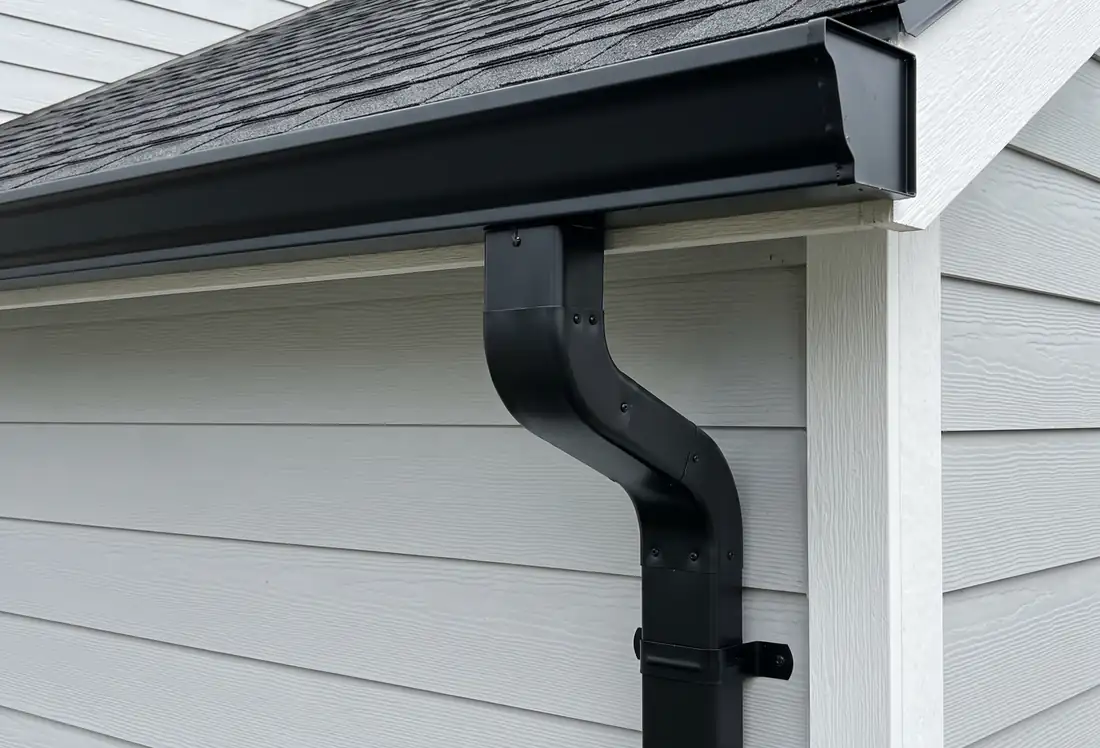
A bigger gutter only helps if the water can leave it. A 3x4 downspout drains far more than a 2x3, and it is less likely to clog with maple seeds or oak catkins. Adding an extra outlet near a valley often does more than upsizing the whole run. A good contractor looks at where the water lands on the roof, not just at the gutter size.
Houses in Fort Wayne that often need 6-inch
- Two-storey houses in Aboite, Huntertown and Leo-Cedarville with big, steep roofs and valleys.
- Older two-storey homes in Forest Park, South Wayne and Williams-Woodland Park where the main roof drains onto a porch roof.
- Houses with metal roofs, which shed water very quickly.
- Additions where a new roof was tied into an old one, creating a valley over a short gutter run.
Snow, ice and 6-inch gutters
A 6-inch gutter holds more snow and ice, which means more weight in winter. Fort Wayne averages about 33.6 inches of snow. Six-inch gutters should be hung on hidden hangers screwed into solid fascia at close spacing, and heavier coil is worth considering. Larger downspouts also help meltwater drain instead of refreezing in the trough.
Signs your gutters are too small
- Water sheets over the front edge in heavy rain, even right after a cleaning.
- Overflow is worst at inside corners below valleys.
- Splash marks and worn soil under one section of eave.
- Downspouts that run full and still cannot keep up.
If any of these sound familiar, read about leaking and overflowing gutters too; sometimes the fix is pitch or a blocked outlet rather than size.
What to ask about 6-inch gutters
- Which parts of my roof need 6-inch, and which can stay 5-inch?
- Will you use 3x4 downspouts, and where will the outlets go?
- What coil thickness and hanger spacing are you quoting?
- How will the new gutter sit under the drip edge?
A worked example
Here is an illustration, not a quote. A two-storey house in Leo-Cedarville has 210 feet of 5-inch gutter that overflows at two inside corners in every storm. Upgrading the whole house to 6-inch at about 50 cents to $1 a foot more would add roughly $105 to $210 over the cost of 5-inch, plus larger downspouts. Alternatively, upsizing only the two problem elevations and adding outlets at the valleys might solve it for less. A contractor can compare both.