
On this page
- What is a micro-mesh gutter guard?
- How much do micro-mesh guards cost in Fort Wayne?
- Micro-mesh vs other guards
- Which Fort Wayne trees call for micro-mesh?
- Micro-mesh and Fort Wayne winters
- How micro-mesh is installed
- Maintenance
- Where micro-mesh makes the most sense
- What to ask about micro-mesh
- A worked example
What is a micro-mesh gutter guard?
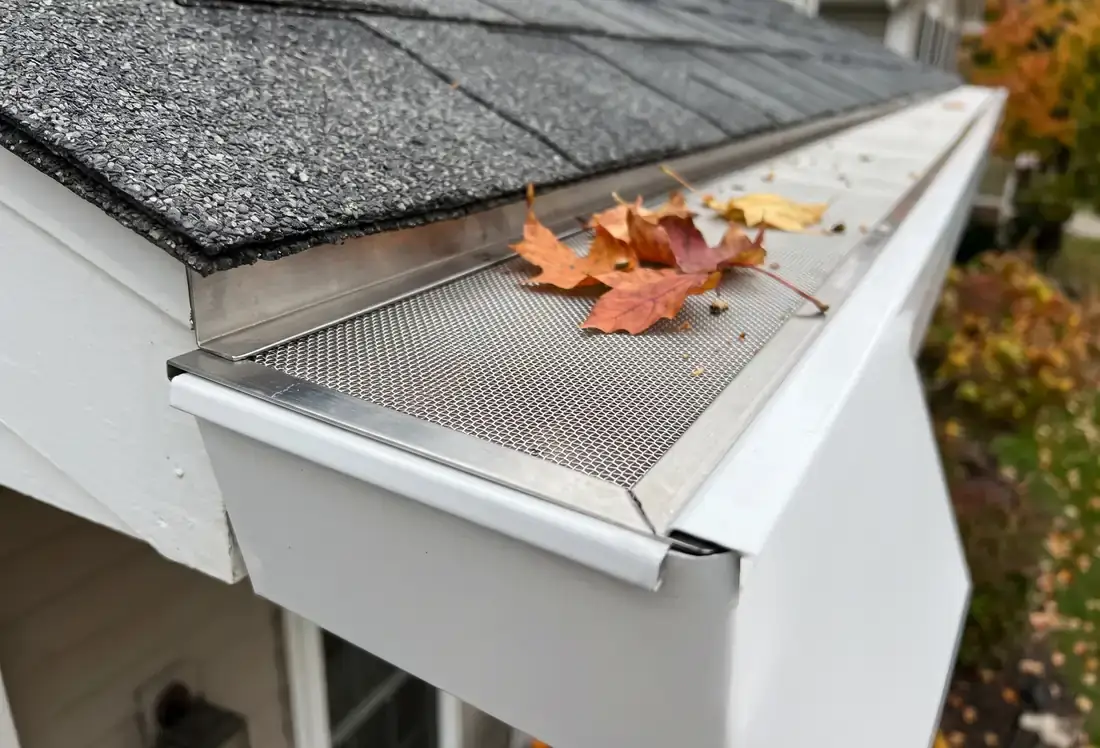
A micro-mesh gutter guard is a fine stainless steel mesh, usually set in an aluminum frame, that covers the gutter and lets water through while keeping out almost everything else. The openings are small enough to stop maple seeds, oak catkins, pine needles and the grit that washes off asphalt shingles. That is the debris that defeats coarse screens and foam inserts, and it is exactly what falls on many Fort Wayne roofs.
How much do micro-mesh guards cost in Fort Wayne?
Angi lists micro-mesh materials at about $2 to $4 per linear foot, and HomeAdvisor puts professionally installed guards at about $6 to $13 per linear foot. Angi reports an average gutter guard job of about $1,514. Stainless micro-mesh from established brands sits toward the top of those ranges. Height, the total footage, the number of corners and any gutter repairs needed first move a Fort Wayne quote.
Micro-mesh vs other guards
| Micro-mesh | Screen | Reverse curve | Foam or brush | |
|---|---|---|---|---|
| Maple seeds | Stops | Often pass | Mostly stops | Trap them |
| Pine needles | Stops | Lodge in holes | Mostly stops | Trap them |
| Oak leaves | Stops | Stops | Stops | Partly |
| Shingle grit | Stops | Passes | Passes | Traps |
| Heavy rain | Good when clean | Good | Can overshoot | Slows flow |
| Cost | Highest | Low | High | Lowest |
See screen and reverse-curve guards for the alternatives.
Which Fort Wayne trees call for micro-mesh?
- Silver and red maples, whose spring "helicopters" slip through screens.
- Oaks, which drop catkins in spring and leaves and acorns in fall.
- White pine and spruce, whose needles lodge in screen holes.
- Honeylocust, a common street tree with tiny leaflets.
- Sweetgum, whose spiky gumballs sit on top of guards.
Fort Wayne removed about 13,000 ash trees after the emerald ash borer arrived, and replacement plantings of mixed species will drop seeds and leaves for years to come.
Micro-mesh and Fort Wayne winters
Snow and ice sit on top of micro-mesh the same way they sit on the roof, and the guard does not prevent ice dams. In a city with about 33.6 inches of snow a year, the key is fastening: the guard should be screwed to the gutter lip and fastened at the back so it cannot lift or bend under snow. The gutter beneath must be strongly hung, because it still carries the weight of any ice. Read ice dams and gutters.
How micro-mesh is installed
- Clean and flush the gutters and downspouts.
- Repair first: rehang sagging runs, reseal corners, fix soft fascia.
- Fit the guards to the gutter lip and the fascia or roof edge, as the manufacturer specifies.
- Cover corners and valleys carefully; that is where debris piles up.
- Test with a hose to make sure water enters the gutter.
Maintenance
Micro-mesh is low-maintenance, not no-maintenance. Under heavy maples and oaks, a film of pollen, seed fluff and fine debris can build up and slow water entry. A soft brush or hose from a ladder once or twice a year usually restores it. Downspouts should still be checked.
Where micro-mesh makes the most sense
Tree-lined older neighborhoods such as Forest Park, Southwood Park, Wildwood Park, Indian Village and Foster Park, and wooded lots in Aboite and Leo-Cedarville. Two-storey houses where cleaning is difficult also benefit most.
What to ask about micro-mesh
- What mesh material and opening size?
- How is it fastened at the front and back?
- Does it affect my roof warranty?
- Will you repair the gutters first?
- What warranty covers the guard and installation?
A worked example
Here is an illustration, not a quote. A ranch in Forest Park with 150 feet of gutter under two silver maples clogs every spring. Micro-mesh at the national installed range of $6 to $13 a foot would cost roughly $900 to $1,950. If the owner pays for three cleanings a year at about $167 each, the guards could pay back in two to four years.